

The call to prayer drifted over the rooftops and died in the concrete.
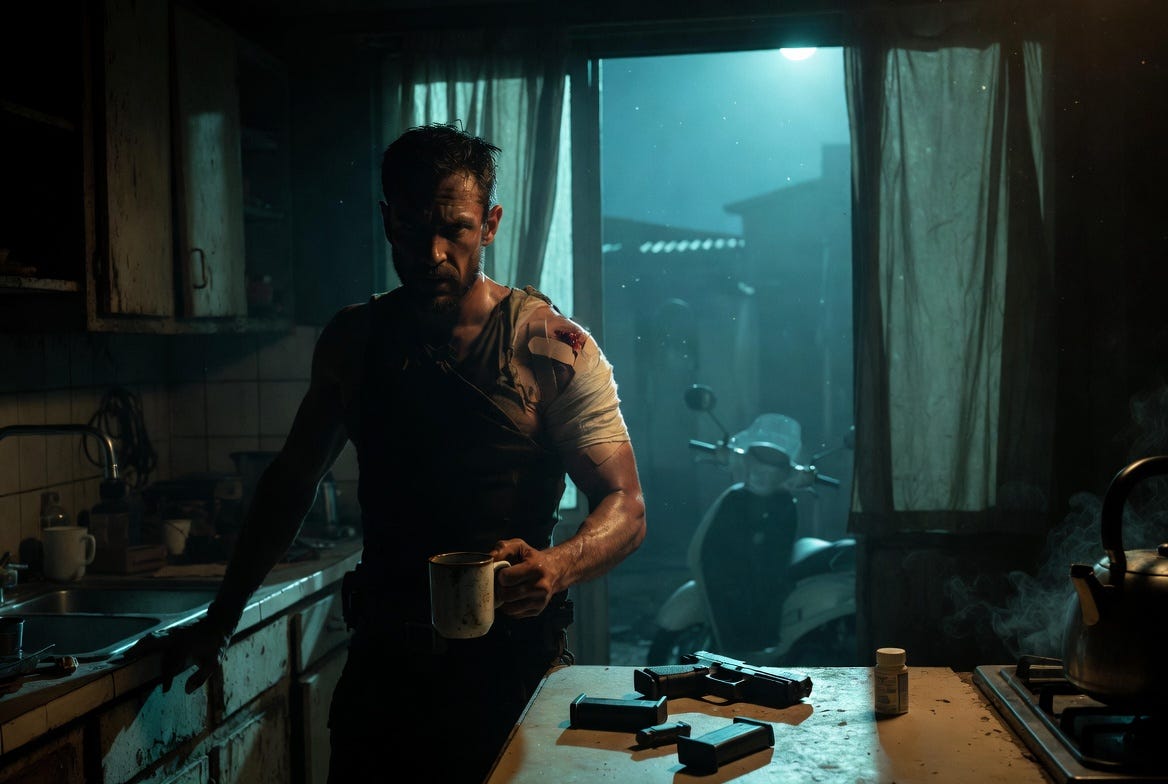
Bishop stood in the dark kitchen of the safehouse with his left hand braced against the sink and his right hand wrapped around a chipped coffee mug gone cold hours ago. The room smelled like dust, bleach, and old wiring. The kind of smell buildings got when people used them hard, then forgot them. He had always liked places like this. No family photos. No memories in the walls. Nothing to lose.
His shoulder throbbed in sharp pulses under the bandage Elena had wrapped the night before. Every pulse was a reminder. Knife steel. Bone shock. Blood down his arm. He rolled the joint once and stopped when white pain flashed from collarbone to wrist.
Still attached. Still mostly works. Good enough.
He checked his watch. 21:47.
Late evening. Day after the rescue.
He had slept in forty-minute blocks all day, if it counted as sleep. More like drifting under and snapping back up at every car door, every motorcycle, every voice in the alley below. Elena had done the same from the other room. Two wounded people taking turns pretending they were fine.
He set the mug down and opened the top cabinet. Inside sat his gear laid out with careful spacing.
Glock 19. Cleaned. One magazine in, one spare beside it.
HK416 propped against the wall by the door, suppressor off for now, bolt locked back for inspection.
SR-25 in its case under the cot in the front room, barrel wiped, scope caps down.
One frag. One smoke.
And the pill bottle.
He picked it up. Shook it once. Plastic rattle. Nine capsules.
Nine is not a lot. Nine is enough if you lie to yourself.
He put it back exactly where it had been.
Behind him, Elena said, “You do that every hour?”
He did not turn. “Every forty-five minutes.”
“Counting pills?”
“Counting everything.”
She moved into the doorway, barefoot, wearing one of the spare shirts from the safehouse cache rolled at the sleeves. Her bruises had started changing color. Purple to green at the edge of her jaw. The left eye was still swollen but open. The split in her lip had crusted over. She looked like someone who had gone ten rounds with a truck and refused to stay down.
Functional. Hurt. Dangerous anyway.
He nodded at the kettle in her hand. “You should be resting.”
“I brewed tea.” She held up the kettle. “This is me resting.”
“You should be horizontal while resting.”
“You should be in a hospital.”
He almost smiled. Almost.
“So we’re both making bad choices,” she said.
“Looks that way.”
She set the kettle on the stove and lit the burner with a click. The flame hissed blue. Her right hand trembled once, then steadied. She thought he had not seen it. He had.
Hands shake when the adrenaline debt comes due. She is paying interest now.
He moved to the front room and checked the window slit overlooking the alley. The curtain was cut with a thumb-wide gap. He had cut it himself that morning with a razor from the med kit. The gap gave him one angle on the back door of the electronics shop and a partial angle on the alley mouth twenty meters east.
Nothing unusual. One parked scooter. Rust-red sedan with a cracked windshield. Two boys walking fast with boxes of bread under their arms.
He let the curtain fall.
Elena set two cups on the table. Steam climbed in thin threads.
“You need to change that dressing,” she said.
“In an hour.”
“Now.”
He looked at her.
She met it without blinking. “If it gets infected, your shoulder goes septic. If your shoulder goes septic, you die or lose the arm. Either outcome hurts our plans.”
“You always this charming?”
“Only with stubborn men carrying rifles in kitchens.”
He sat. She pulled the tape from his shoulder with slow pressure and no warning. Pain ripped through him, bright and clean. He did not flinch. His jaw tightened anyway.
The gauze underneath was sticky dark red at the center.
Elena leaned closer, studying the wound under the weak overhead bulb. Her brow furrowed.
“No fresh bleeding. That’s good,” she said. “Edges are angry but not rotten yet.”
“That a clinical term?”
“It’s a technical term where I trained.” She poured saline from a plastic bottle and began cleaning the cut. “Stop moving.”
“I’m not moving.”
“Your pulse is jumping.”
Because this feels like someone dragging barbed wire through my shoulder.
He breathed in through his nose. Four count. Out through his mouth. Six count. Old drill from another life. Control what you can.
“Where did you learn to do this?” he asked.
“Aleppo, first time. Mosul, second. Third time was Kyiv. After that I stopped counting.”
“Patch yourself up often?”
“Enough to be useful.” She taped fresh gauze in place and pressed around the wound with two fingers. “Any numbness in the hand?”
He flexed his fingers. “No numbness. Weakness.”
“Pain scale?”
“Eight.”
“That’s your real number or your operator number?”
“Seven and a half.”
“Thank you for your honesty.”
He snorted once. It turned into a cough that stabbed his ribs.
She watched him ride the pain out.
“Ribs still bad?”
“Bruised. Not broken.”
“How sure?”
“If they were broken, breathing would be worse.”
“Could still be a hairline.”
“Could be.”
“And your plan is to ignore it.”
“My plan is to stay alive long enough to solve the problem.”
She sat back and studied him like a document she did not trust yet. “You know what’s strange?”
“Most things.”
“You keep talking about survival. But half your decisions look like you’re trying to cash out.”
The room went still.
Street noise filtered through the walls. Distant engine. Someone shouting three buildings over. Then silence again.
She sees too much. That’s her job. That’s the danger.
He reached for the tea. It had gone from hot to warm. “You didn’t survive what they did to you by being polite.”
“No.”
“Then don’t expect polite answers.”
She held his gaze a beat longer, then nodded once. “Fair enough.”
He set the cup down.
“You said last night you couldn’t decode what you memorized without a key,” he said. “I need more than that. Start at the beginning. All of it.”
Elena folded her hands on the table. Her knuckles were split and healing crooked.
“Six months ago a source approached me in Istanbul,” she said. “Former operations support. Not field. Accounting and transport. He was dying. Liver cancer. He wanted insurance before he went.”
“Insurance is files.”
“Insurance was me. He didn’t trust digital storage. He said every server can be erased and every hard drive can be burned. Memory is harder to raid if you compartmentalize it.”
Bishop nodded. “Memory palace.”
“Yes.” She looked surprised he knew the term. “He gave me segments in three rounds over twelve days. Each segment tied to imagery. Places I know, physical objects, sequences.”
“How many segments?”
“Thirty-six primary. Twelve secondary tags.”
He did the arithmetic automatically. “Forty-eight total data points.”
“Correct.”
Forty-eight. Too many for improvisation. Enough for network mapping if real.
“What are they?”
“Partial names. Routing markers. Payment windows. Front companies. Port codes. Two operation labels. And three references to an authorization chain above standard oversight.”
“Names?”
“Not full names. Fragments. Initials. Family offices. Trust accounts.”
“Operation labels?”
“One is PROMETHEUS, obviously. The second is called ORCHARD GLASS.”
He filed it.
Could be real. Could be bait. Could be both.
“And the key?”
“The source held half. Ashworth held half. That’s what I was told.”
“You trusted that?”
“I trusted that the source believed it.”
“Difference matters.”
“I know.”
She took a slow breath, eyes on the steam between them.
“Ashworth was the one who made contact after the first round,” she said. “Secure apartment in Rome. No phones. He knew things he should not have known, including where I’d met the source and what color coat I wore.” She rubbed her thumb against a bruise on her wrist. “He said he represented a compartment inside CIA trying to expose PROMETHEUS from within.”
“Did you believe him?”
“I believed he was connected. I did not believe his whole story.”
“Good.”
“He gave me one rule. If I got burned, do not call, do not write, do not run to an embassy. Stay alive and force a signal. He would find me if he thought I still had value.”
“How?”
“By pattern disruption.”
“Meaning?”
“I break routine in ways only he would recognize.”
He leaned back slowly, careful of the shoulder. “Give me an example.”
“I publish a specific phrase in a place he monitors. Or I access an old account once, from a known region, then disappear. Or I leave a symbol in a transit hub under camera.” She looked up. “He does not like direct lines. He likes indirection and leverage.”
“He likes control.”
“Yes.”
Men like that don’t rescue people. They acquire them.
He stood and crossed to the window again, scanning the alley through the slit.
Same sedan. Same scooter.
Different man at the alley mouth now. Tall, baseball cap, holding a plastic bag, pretending to check his phone while not moving for twenty seconds.
Bishop counted to ten in his head.
The man moved on.
Maybe nothing. Maybe not.
He returned to the table.
“PROMETHEUS knows you escaped,” he said. “Kazan had a full team and a secure site. They lost fourteen men and their prize in one night. Somebody above him is bleeding money and reputation right now. They will answer that.”
“I know.”
“No, you feel it. That’s different.” He tapped the table with one finger. “Answer me clean. During interrogation, did they ask for Ashworth by name?”
“No.”
“Did they ask for key structure?”
“Yes. Repeatedly.”
“Exact language.”
She closed her eyes a moment. Reconstructed it.
“They kept saying, ‘Sequence order. Sequence order. Who gave sequence order.’”
“Not passphrase. Not code word. Sequence order.”
“Yes.”
That means transform key, not static key. They need structure, not just content.
“They don’t have the mechanism,” he said. “They might have some of the data already, maybe from your source, maybe from another leak. What they don’t have is arrangement.”
Elena opened her eyes. “That’s what I thought.”
“If true, you’re still the lockpick.”
“Or the lock.”
“Both.”
He glanced at the wall clock. 22:18.
They had maybe hours before first probe. Maybe less if PROMETHEUS already had watchers on transit lanes and medical points.
“Tell me about this signal protocol with Ashworth,” he said. “What’s the fastest trigger you can set from here with what we have?”
She frowned. “Fastest is an old journalist account on a regional wire board. I used it once years ago. Dead identity. If I log in and post one line, he may see it.”
“May isn’t good.”
“Nothing is good.”
“What’s better than may?”
“There’s a second trigger. Riskier.”
“Go.”
“A physical marker in the medina. Tile wall behind Bab al-Bahr archway. Three chalk marks in a pattern. He told me once if I ever had no comms, use that.”
Bishop stared at her.
“You told me he finds you.”
“Yes.”
“But this needs you to walk into public and tag a wall.”
“I said he likes indirection. Not convenience.”
He considered routes. Safehouse to medina by vehicle took fifteen to twenty minutes in normal traffic. On foot too exposed. Night traffic offered cover and choke points. Also more witnesses. More cameras. More militia drunks with rifles and opinions.
With his shoulder like this, running a vehicle ambush would be ugly.
Ugly still beats static and surrounded.
“Not tonight,” he said.
She stiffened. “We don’t have time to wait.”
“We wait until I map the street pattern one more cycle and set exits. Then we decide if we move.” He leaned in. “You were in a cell yesterday. I was bleeding out in a stolen truck yesterday. Tonight we do not sprint blind because Ashworth likes theater.”
Elena’s mouth hardened. “And if PROMETHEUS gets here first?”
“Then we kill them and move.”
“With one arm?”
“With one arm and bad manners.”
That drew the ghost of a smile from her, gone fast.
He pulled a folded city map from his pack and spread it across the table. Grease pencil circles from earlier covered half the district.
“Look.” He pointed. “Safehouse here. Two primary exits. Rear stair to alley. Front stair to shop floor, then shutter. One tertiary route through roof to adjacent building, then south ladder.”
She tracked his finger.
“Observation points here, here, and here,” he continued. “If they run a snatch, they need one eye at the alley mouth, one near the bakery, one mobile bike. If they run a hit team, they stage two blocks out and push fast.”
“What about drones?”
“Possible. Small quad in this district at night stands out by sound. Harder with fixed wing, but they need open lane and they need cueing.”
“Cueing from watchers on the ground.”
“Exactly.”
He handed her the grease pencil. “Mark where you’d place surveillance if you were hunting yourself.”
She did not hesitate. Marked four points.
He looked at them and nodded slowly.
Two matched his own.
The other two were better.
She learns pattern under fire. Useful.
“Good,” he said.
“Good enough to get us out?”
“Good enough to improve our odds from terrible to bad.”
“Encouraging.”
“I aim to please.”
He got up, retrieved the HK416, and checked the chamber out of habit. Empty. He seated a mag and let the bolt ride forward with a soft metallic snap. Sling over right shoulder, careful with left.
“Stay off the windows,” he said. “No lights in the front room. If I’m not back in twelve minutes, go to roof exit and wait five more. If still no contact, move south to route Charlie.”
“Route Charlie goes where?”
“Bus terminal storage yard.” He met her eyes. “You remember it?”
She repeated the path back to him. Exact. He nodded.
“You going out there now?” she asked.
“Two-minute perimeter check.”
“With that shoulder?”
“With these eyes.”
She stood before he reached the door. “Take this.”
She held out a slim folding knife from the med kit pouch, black handle worn smooth.
“I already have one.”
“Then carry two.”
He took it and tucked it into his pocket.
Trust is weird. Sometimes it looks like steel and tape and bad tea.
He moved down the rear stair in darkness, counting each step. Ten to landing. Seven to steel door. He paused, listened.
No voices. No scrape. No weight shift against metal.
He opened the door one inch and looked through.
Alley quiet.
He slipped out, closed it without sound, and made a slow loop along shadowed walls, using parked vehicles as mirrors. Three minutes. No obvious tail. A cat bolted from under a dumpster and nearly earned a bullet.
At the alley mouth he paused near a broken mirror leaning against bricks. Reflected in the glass, up on the third-floor balcony opposite, something glinted once.
Lens.
Could be camera. Could be binocular objective catching stray light.
He kept walking. Did not look up again. Turned left, then left again, then back to the safehouse through a different line.
Inside, he locked the door and slid the bolt.
“We have eyes,” he said.
Elena’s face went flat. “How close?”
“Within one block. Maybe closer.”
“Then we move now.”
“Not yet.”
“Bishop.”
“Listen.” He laid the HK416 on the table and pointed at the map. “If they only have surveillance, moving right now gives them pattern and destination. We need to make them commit before we expose our route.”
“How?”
“You send your trigger.”
She stared at him. “You just said not tonight.”
“For physical marker. Digital is different. One pulse. Thirty seconds online from this building is bad. Thirty seconds through a burner with no personal tie and a spoofed relay is survivable."
“We don’t have a throwaway device.”
He reached into a vent above the sink and pulled out a dust-coated plastic pouch. Inside were two old feature phones with batteries wrapped separate in foil.
Elena blinked. “You’ve had those here the whole time?”
“I had lots of things here.”
“I hate that this is attractive.”
“You should hate everything about me.”
“Working on it.”
He checked one phone. Battery contacts clean. Power up took six seconds. Signal bars rose, then settled at two. Good enough.
He handed it to her.
"One login," he said. "Text gateway only. No browser. No extra clicks. No scrolling. No nostalgia."
“I don’t get nostalgic about old burner identities.”
“Good.”
They moved to the back room where concrete walls blocked direct line from street windows. He killed all lights except a red penlight pointed at the floor.
Elena typed from memory, thumbs quick despite stiffness in her wrists.
“What’s the phrase?” he asked.
“If I say it out loud and we get audio, it’s burned.”
“Fair.”
She hit send and looked up. “Done.”
“Log out. Pull battery.”
She did.
He took the phone, removed the SIM, snapped it between pliers from the tool kit, and dropped the pieces into separate cups of water and bleach.
“Subtle,” Elena said.
“Subtle died a while back.”
He checked his watch. 22:46.
“How long for Ashworth reaction if he sees it?”
“Could be one hour. Could be twelve. Could be never if he’s dead or compromised.”
“And PROMETHEUS reaction?”
“If they monitor the same board, maybe immediate.”
“Then we assume immediate.”
He began repacking gear with practiced speed constrained by shoulder pain.
HK416 slung, two spare mags taped low for right-hand access.
Glock holstered appendix for draw with either hand.
SR-25 cased for transport.
Frag and smoke wrapped in cloth and placed in side pouch.
Cash envelope split into two stacks.
IDs split same way.
Pills back in jacket inner pocket.
He handed Elena a compact pistol from the safehouse lockbox, magazine seated, chamber clear.
“You know this platform?”
“Enough.”
“Show me.”
She racked, press checked, reholstered in one smooth series. Not perfect, but better than civilian range habits.
“Good,” he said. “Rule one. If we split, you do not stay and fight. You run route Charlie.”
“I don’t leave you.”
“You do if I tell you.”
“No.”
“Elena.”
“No.” Her voice stayed low but hard. “I got dragged out of a room in zip ties because I worked alone too long and trusted the wrong walls. I’m done with that. We move together unless one of us is dead.”
The words hung there.
He looked at her, really looked at her. Bruises. Swollen eye. Split lip. Spine straight.
She means it. Not drama. Decision.
“Fine,” he said. “Together unless dead.”
“Thank you.”
“Don’t thank me yet.”
He crossed to the front room and took another slit-angle look at the alley.
The red sedan was gone.
A white delivery van now sat where it had been, engine off, no logos, no driver visible.
That is not random. That is a chess piece.
He pulled back from the curtain.
“We have a van in kill box one,” he said.
“Could be delivery,” Elena said, but not like she believed it.
“At eleven at night with no markings?”
“Fair point.”
He set a thumb-sized shard of mirror on the windowsill angled toward the stairwell inside the building. Old trick. Anyone coming up from below would reflect in the fragment before they reached the landing.
Then he dimmed the penlight and listened.
Nothing.
Minutes dragged.
At 22:59, a motorcycle rolled slowly past the alley mouth. No headlight. Two riders. Helmets. They did not stop. They did not need to.
“Spotters,” Bishop whispered.
Elena crouched beside him, staying out of line with the window slit. “They’re setting a net.”
“Yes.”
“Do we still wait?”
He answered without looking at her. “No.”
He shouldered the SR-25 case and nodded toward the rear hall.
They moved in silence.
At the steel rear door he paused and checked the strip of black thread he had taped across the frame at shin height when he came in fifteen minutes earlier.
The thread hung loose. One side peeled clean from the jamb.
Someone had defeated the outer lock while they were inside. The bolt had held, but the warning thread was loose.
His skin went cold.
Inside perimeter breach. Could be minutes old. Could be now.
He raised one hand to stop Elena.
Then they heard it.
From the stairwell below, one floor down.
Three soft knocks on metal. Even spacing. Professional patience.
Not police. Not random.
Elena’s breath hitched once.
Bishop leaned to her ear.
“That’s our complication,” he whispered.
A beat later, his old satellite phone in the kitchen, dead for months and connected to nothing he trusted, began to ring.
One tone. Two.
He looked at Elena.
She looked back, face pale under bruises.
“Ashworth?” she mouthed.
Bishop did not answer.
He drew the Glock and kept his eyes on the door.
The phone kept ringing.
Below them, on the stairwell, the unknown hand knocked three times again.
Then waited.
Was really looking forward to reading the next chapter! Thanks for posting!
What a great chapter! Bishop and Elena's dialogue was sharp and kept the story moving at a quick pace. All this while in the safe house, well done. So many cinematic moments and lines, my favorite is Bishop's comeback, “With one arm and bad manners.” Haha, love it. Great work Dallas.