

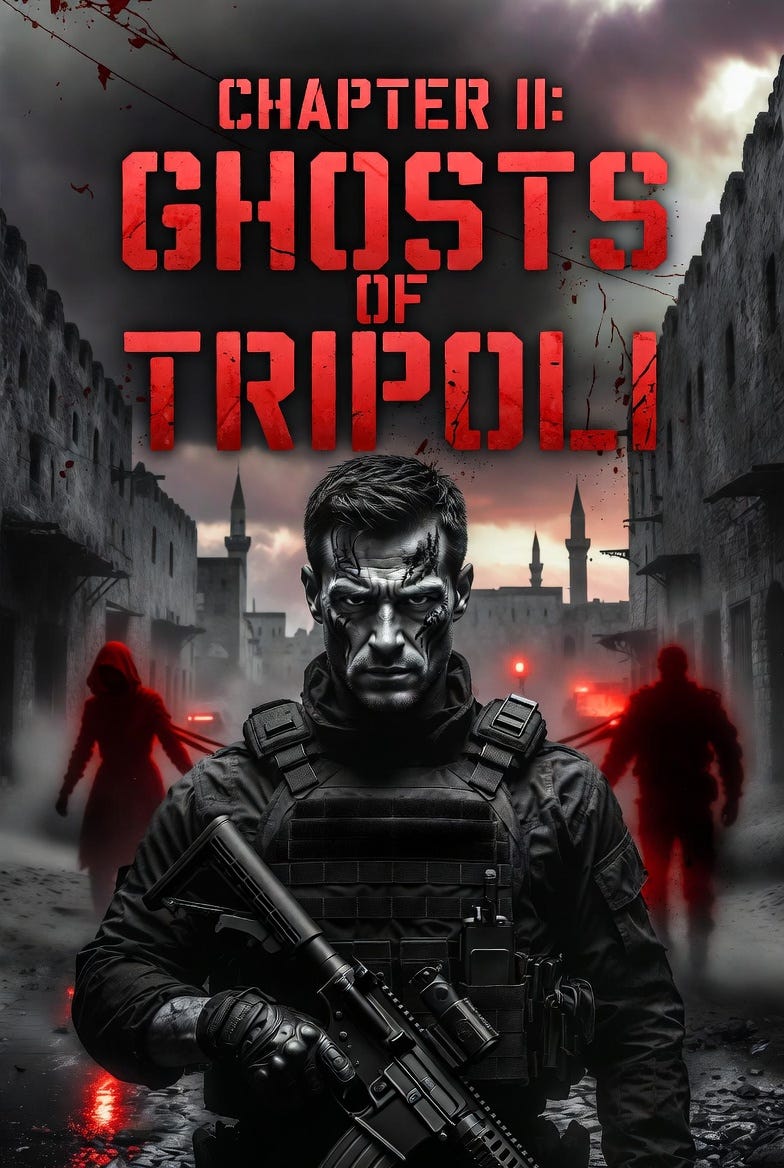
Bishop walked for ninety minutes before he let himself breathe.
Through back alleys stinking of rotting vegetables. Past apartment blocks where laundry hung like surrender flags in the dark. Along the waterfront where fishing boats knocked against their moorings in the oily swell. He never took the same route twice. Never stayed on a single street for more than a block. Counter-surveillance had become reflex over the years, the way blinking was reflex. The way killing was reflex.
The city was waking up around him. Vendors setting up stalls. Children in school uniforms. Women in hijabs carrying groceries. Ordinary people living ordinary lives, oblivious to the dead men cooling in an alley across town. Oblivious to the woman being driven to whatever hole they’d prepared for her.
Bishop found a safe house. One of three he maintained in the city. A single room above a mechanic’s shop, paid six months in advance in cash to a landlord who’d never asked his name. The stairs groaned as he climbed them. The lock took three tries with his shaking hands.
Adrenaline crash. It always came eventually. The hands first, then the legs, then the whole body trembling like a junkie in withdrawal. He’d learned to ignore it. Learned to function through it. Learned to file it away with all the other damage that accumulated in a life like his.
The room was small and spare. A cot. A sink with rust stains bleeding down the porcelain. A window covered with newspaper that let in gray fragments of the approaching dawn. Bishop crossed to the sink, cranked the handle, and watched brown water sputter from the tap until it ran clear.
He washed his hands first. The blood came off in ribbons. Not his. The sniper’s. The kid who’d died calling him bait.
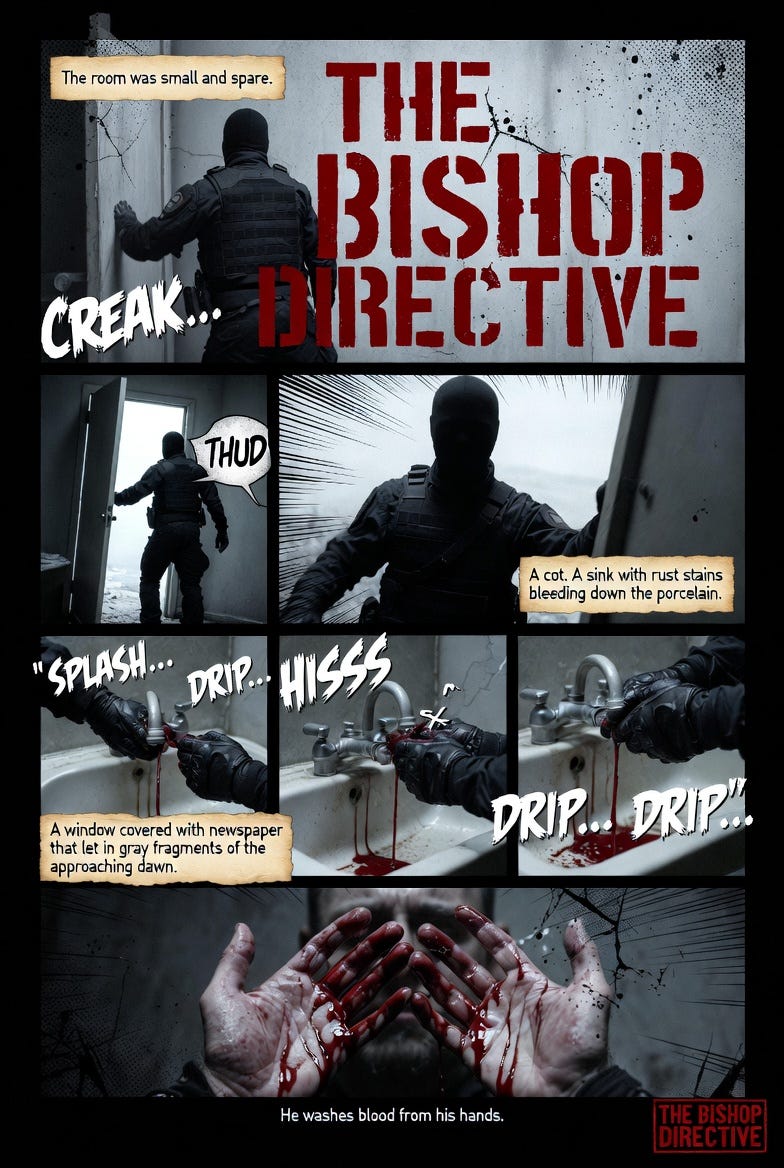
Then he stripped off his jacket and shirt and bent over the basin.
The mirror above the sink was cracked down the middle. It split his reflection into halves that didn’t quite align, the image shattered like his memories of a life before all this. Bishop studied himself the way he’d study a target. Clinical. Detached. Looking for damage.
The face that stared back was weathered beyond its forty-one years. Dark hair cut military short, going silver at the temples. Eyes the color of worn steel, deep set and constantly moving, cataloging threats that might not exist. A web of fine scars traced his left cheekbone, souvenirs from a window he’d gone through in Fallujah. A thicker line ran along his jaw where a Chechen’s knife had opened him up during a job that officially never happened.
He was six-two, lean and hard from decades of operational fitness. No bulk. No wasted mass. Just functional muscle built for violence and sustained movement. His body was a tool. He’d maintained it the way he maintained his weapons. Now both were showing wear.
A bruise was spreading across his ribs where he’d hit the ground during the sniper engagement. Purple and yellow, already tender to the touch. He probed it with careful fingers. Nothing broken. Nothing shifted. Just soft tissue damage that would hurt like hell for a week.
Water dripped from his face as he leaned on the sink. The man in the mirror looked tired. The man in the mirror looked old. The man in the mirror had been supposed to die tonight, and some part of him wondered if that would have been the easier outcome.
He pushed the thought down. Buried it with the others.
The pill bottle was in his jacket. He could feel its weight across the room, a gravity that pulled at him constantly. His back had started screaming somewhere around the third mile, the old vertebral damage flaring like someone had driven a spike between his shoulder blades. Two pills would take the edge off. Two pills would let him function.
Bishop dried his face with a dirty towel and pulled on a fresh shirt from the duffel he kept stashed under the cot. Black. Long sleeves. Nothing distinctive. He checked his weapons. Cleared the Glock. Reloaded with a fresh magazine. The HK416 went into a soft case that could pass for sports equipment if nobody looked too close.
Then he sat on the cot and started working the problem.
Someone had used him as bait. That meant someone knew his capabilities, his methods, his likely responses to the scenario they’d constructed. They’d known he’d take the job. Known he’d push through the ambush. Known he’d survive long enough for whatever they were really doing to succeed.
That wasn’t random. That was intelligence. Good intelligence. The kind that came from the inside.
Bishop ran the names in his head. The broker who’d connected him with the job. The contact who’d provided the safehouse coordinates. The source who’d vouched for the asset’s value. Links in a chain, any one of which could be compromised.
Or all of them.
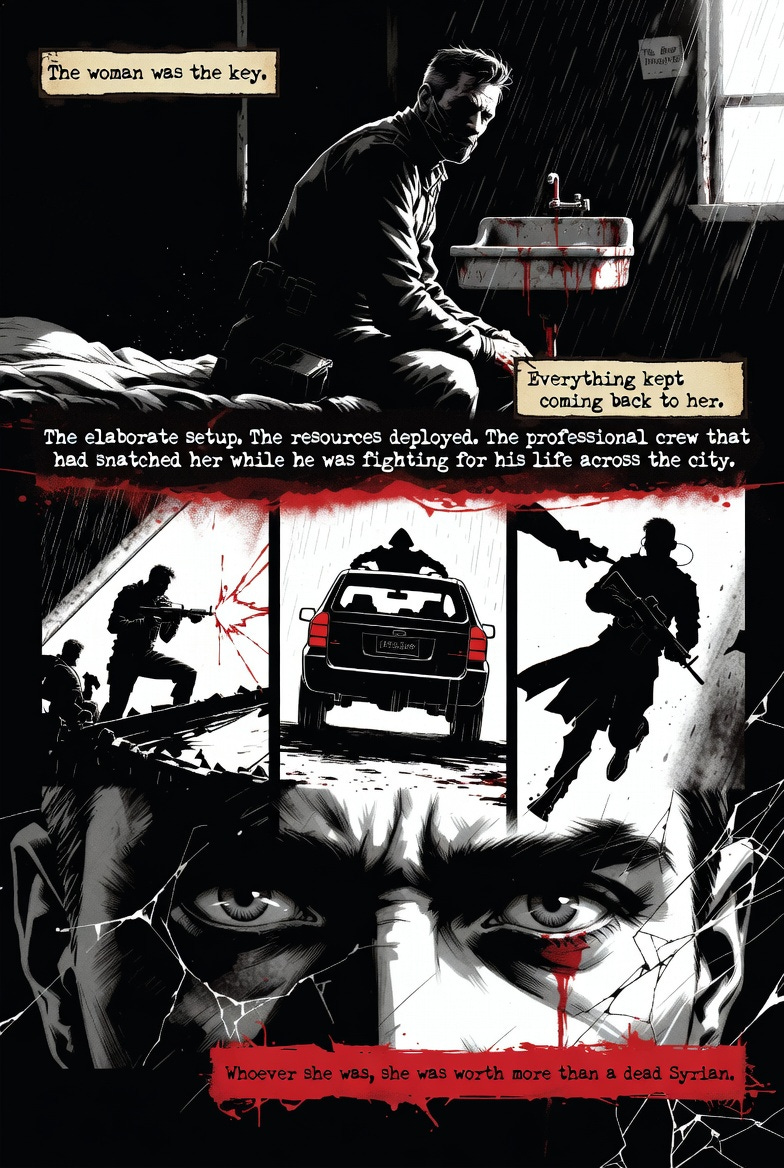
The woman was the key. Everything kept coming back to her. The elaborate setup. The resources deployed. The professional crew that had snatched her while he was fighting for his life across the city. Whoever she was, she was worth more than a dead Syrian intelligence officer and four expendable contractors.
Worth more than Bishop himself.
That stung somewhere deep. Not his ego. His training. An operator was never just a distraction. An operator was a primary asset. Someone had flipped that equation, reduced him to a piece on someone else’s board, and the part of him that had spent twenty years being the best at what he did couldn’t accept it.
He needed information. He needed leverage. He needed Halim.
The old Palestinian ran his network out of an antique shop in the medina, surrounded by Ottoman ceramics and Berber carpets and the carefully maintained fiction that he was just a merchant. In reality, he was a junction point. A node where information from a dozen intelligence services flowed together, filtered through a man who owed loyalty to no flag and allegiance only to his own survival.
Bishop had saved his life once. Three years ago, in a situation neither of them talked about. The debt had been acknowledged but never collected. Now it was time.
He checked his watch. 0517. Too early. Halim never opened before nine, and arriving before then would signal desperation. In this business, desperation got you killed.
Four hours. He could use them.
Bishop didn’t sleep in combat theaters. Never had. It was a rule he’d established in the Rangers and never broken in the twenty years since. Sleep meant vulnerability. Sleep meant trusting your environment, your perimeter, your luck. In hostile territory, luck was a finite resource, and Bishop had used more than his share.
Instead, he settled into a state of controlled rest. Back against the wall. Glock in his lap. Eyes half-lidded but tracking the door, the window, the thin strip of light beneath the newspaper where shadows might move.
His body recharged in increments. Muscle tension releasing. Heart rate dropping. But the mind stayed alert, running scenarios, analyzing variables, planning contingencies. It was a skill that had kept him alive when others died. A discipline that separated operators from soldiers.
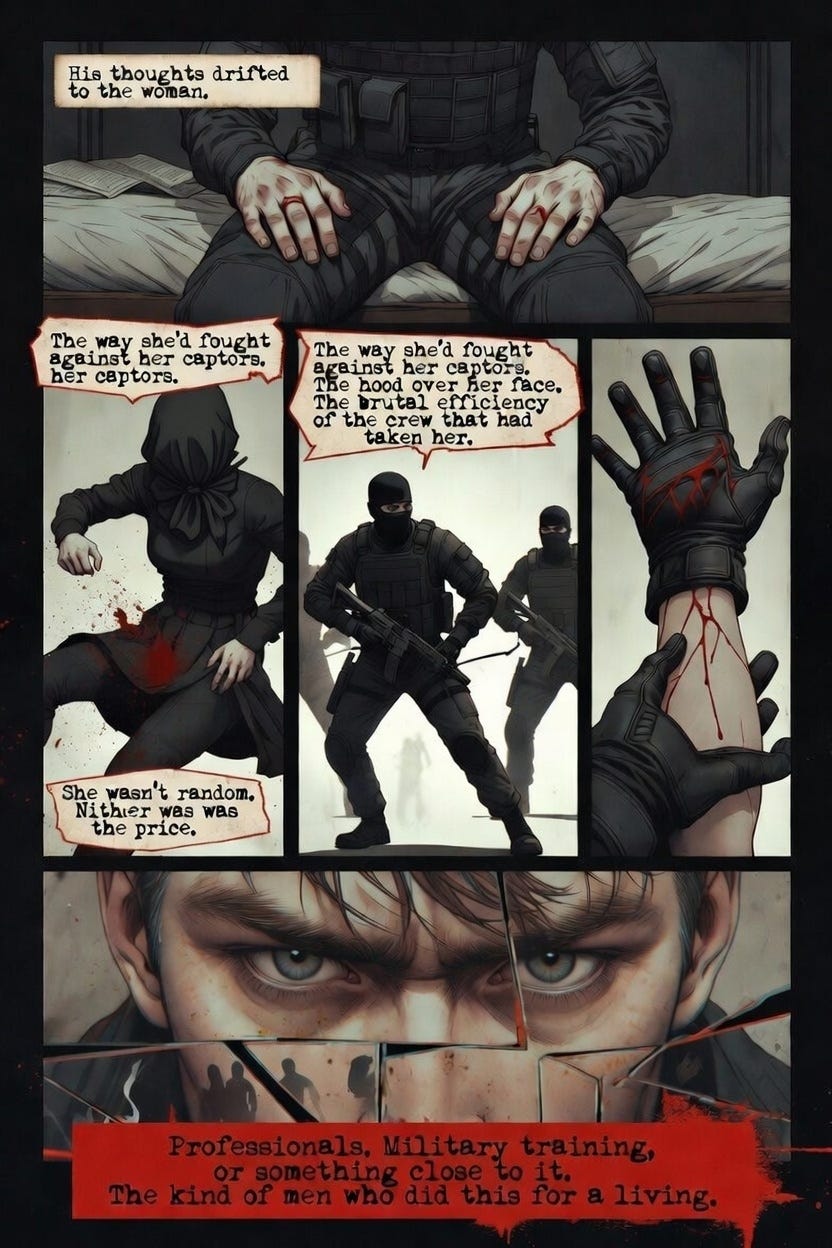
His thoughts drifted to the woman. The way she’d fought against her captors. The hood over her face. The brutal efficiency of the crew that had taken her. Professionals. Military training, or something close to it. The kind of men who did this for a living.
The kind of men Bishop used to work with.
The connection formed slowly, like a photograph developing in chemical bath. The timing. The coordination. The inside knowledge. This wasn’t just organized crime or local militia. This was tradecraft. This was an intelligence operation.
Which meant the people hunting for her were connected to the same world Bishop had been part of for most of his adult life. The shadow world. The deniable world. The world where men and women disappeared and governments shrugged and said they’d never heard of them.
He knew that world. He’d helped build parts of it. He’d also seen what happened to people who got crosswise with its interests.
They ended up like his team. Bleeding out in foreign alleys. Forgotten by the agencies that had sent them. Written off as acceptable losses.
At 0630, Bishop rose from the cot and checked the window. The street below was filling with morning traffic. Scooters. Delivery trucks. Nothing that screamed surveillance. Nothing that felt wrong.
But wrong was exactly what they’d want him to feel. Complacent. Safe. Ready to make a mistake.
Bishop spent the next two hours preparing. He stripped and cleaned the Glock three times. Checked his secondary magazines. Sharpened his knife. Inventoried his emergency kit: cash in three currencies, two sets of identity documents, his IFAK(Individual First-Aid Kit) and tourniquet, a burner phone still in its packaging.
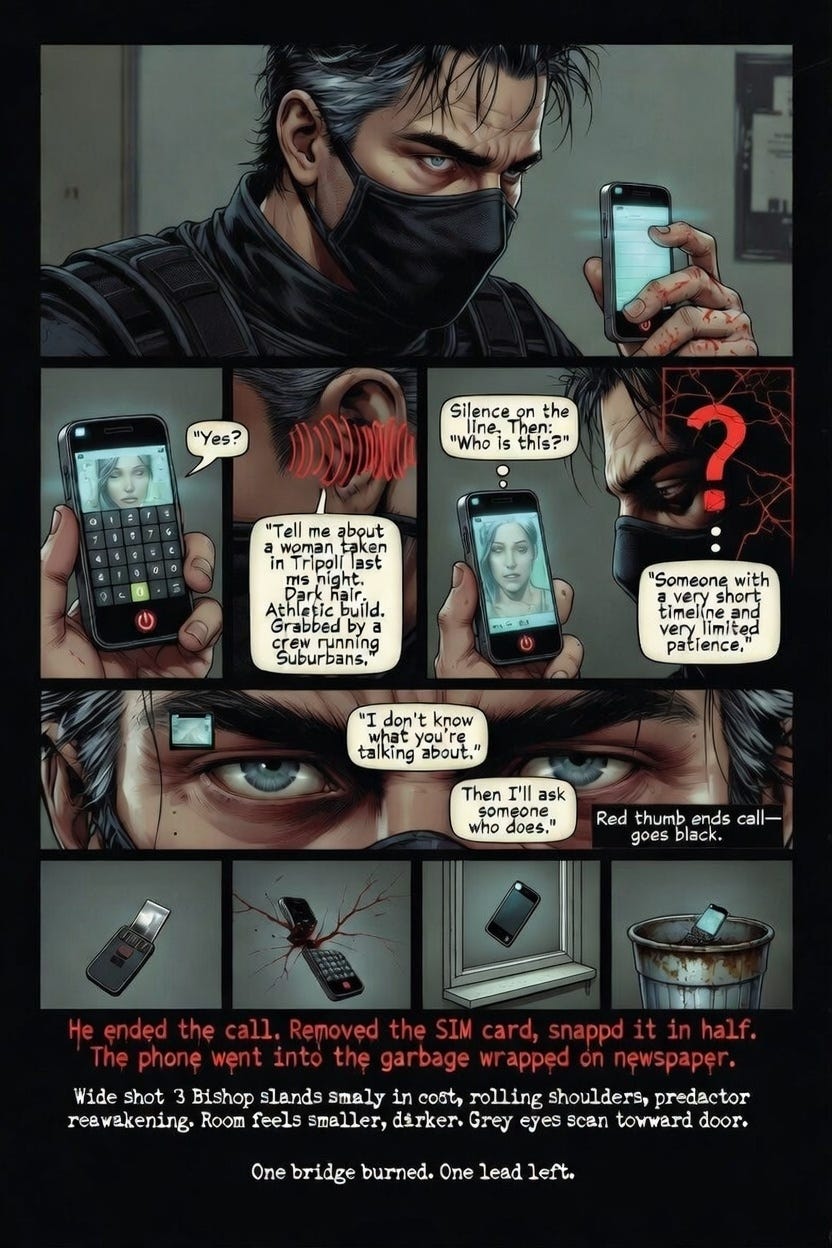
He activated the phone. Powered it on. Made one call to a number he’d memorized years ago and never expected to use.
Three rings. A voice. Female. Tired.
“Yes?”
“Tell me about a woman taken in Tripoli last night. Dark hair. Athletic build. Grabbed by a crew running Suburbans.”
Silence on the line. Then: “Who is this?”
“Someone with a very short timeline and very limited patience.”
More silence. Bishop could hear the woman thinking, weighing options. Whatever game she was playing, she hadn’t expected this call.
“I don’t know what you’re talking about.”
“Then I’ll ask someone who does.”
He ended the call. Removed the SIM card. Snapped it in half. The phone went into the garbage wrapped in newspaper.
The call had been a long shot. Diana Cole, CIA case officer. Someone Bishop had worked with before everything went wrong in Syria. Before the agency had burned him and left four good men dead in a village that no longer existed on any map.
She’d denied knowing anything. That meant she knew something. The pause before her answer had been a fraction too long. The denial a fraction too quick.
Diana was compromised, or she was scared. Either way, she was a thread.
And threads could be pulled.
At 0845, Bishop left the safehouse. He took a circuitous route through the medina, doubling back twice, stopping to examine merchandise at vendor stalls while his eyes swept the crowd for familiar faces. For patterns. For the shape of surveillance.
Nothing.
Either they weren’t following him, or they were very, very good.
He operated on the assumption of the latter.
Halim’s shop occupied a corner position in the oldest part of the market. The sign above the door proclaimed it in Arabic and English: TREASURES OF THE ANCIENT WORLD. The windows displayed pottery and brass lamps and textiles that looked older than the countries they’d come from.
Bishop paused outside. Scanned the street. A boy selling cigarettes from a wooden tray. An old man drinking tea at a cafe across the alley. A woman in a full burqa moving slowly past, her eyes downcast.
Any of them could be hostile. All of them could be innocent. The paranoia was always there now, a constant low hum in the back of his skull, cataloging threats both real and imagined.
He pushed through the door.
The interior was dim and cluttered. Shelves crowded with merchandise. A ceiling lost in shadow. The smell of old dust and incense and something sweeter underneath, something that reminded Bishop of the opium dens he’d seen in Afghanistan.
A figure emerged from behind a beaded curtain. Old. Stooped. Eyes that had seen empires rise and fall and knew they’d see more of the same before the end.
“We are not open,” Halim said.
“I know.”
The old man’s gaze sharpened. Recognition flickered in those ancient eyes. Then something else. Calculation.
“Bishop.” He said the name like a curse. Or a prayer. “You were not supposed to come here.”
“Changed my plans.”
“Dangerous. For both of us.” Halim moved deeper into the shop, gesturing for Bishop to follow. “The streets have ears today. More than usual.”
They passed through the beaded curtain into a back room that was half office, half armory. Maps covered the walls. A bank of communication equipment hummed in the corner. Weapons racked neatly behind glass cases that might have held antique swords to a casual observer.
Halim settled into a chair that looked older than he was. He didn’t offer Bishop a seat.
“I need information,” Bishop said.
“Everyone needs something.” The old man’s fingers steepled. “The question is always what they are willing to pay.”
“I’m calling in the marker.”
Silence. Halim’s expression didn’t change, but something shifted behind his eyes. The marker. The debt. The life Bishop had saved when everyone else had written the old Palestinian off.
“That is a significant currency,” Halim said finally. “I hope you spend it wisely.”
“A woman was taken last night. Eastern part of the city. Professional crew. Six men minimum. Black Suburbans. They grabbed her while I was being used as a distraction across town.”
Halim’s eyebrows rose a fraction. “You were the distraction?”
“The whole operation was theater. The asset was dead before we arrived. My team got cut apart by a sniper who was barely trained enough to pull a trigger. And while all that was happening, they took her.”
“Interesting.” Halim reached for a cigarette from a pack on his desk. Lit it with a silver lighter that had probably been worth more than Bishop’s first car. “And you want to know who she is.”
“I want to know who she is. I want to know who took her. I want to know who orchestrated the operation that left four of my people dead in an alley.”
“That is three questions.” Halim exhaled smoke toward the ceiling. “For one marker.”
“Consider it professional courtesy.”
The old man laughed. A dry, papery sound. “Courtesy. From you. I remember a man who put a gun to my head and explained in great detail what he would do to my family if I didn’t provide the information he needed. Where is that man?”
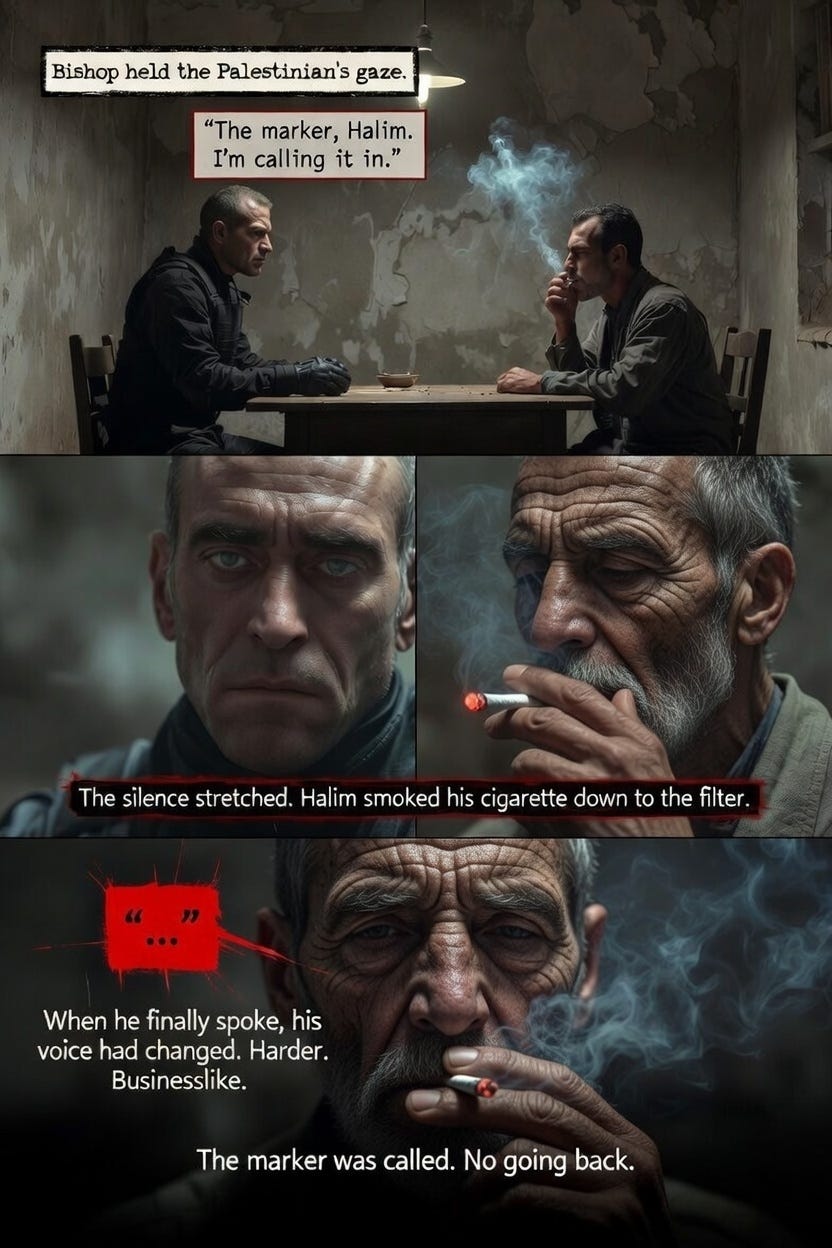
“He got older. Less patient.” Bishop held the Palestinian’s gaze. “The marker, Halim. I’m calling it in.”
The silence stretched. Halim smoked his cigarette down to the filter. When he finally spoke, his voice had changed. Harder. Businesslike.
“The woman’s name is Elena Varga. Hungarian by birth, American by citizenship. Journalist. She writes about things powerful people prefer to keep buried. War crimes. Intelligence failures. Corruption at the highest levels.” He stubbed out the cigarette. “Six months ago, she began investigating something called PROMETHEUS. I do not know what it is. Only whispers. But people who learn too much about it have a habit of disappearing.”
PROMETHEUS. The word meant nothing to Bishop. Yet.
“Who took her?”
“Private military contractors. But not the usual mercenaries. These are ghosts. Former intelligence operatives. Western trained. American, possibly British. Well funded.” Halim lit another cigarette, and Bishop noticed the old man’s fingers weren’t quite steady. “They answer to someone with resources most nation-states would envy. Someone who can make problems disappear. Someone who operates in the spaces between governments.”
“That’s not a name.”
“Because I don’t have a name.” The fear was unmistakable now. Halim, who had survived four decades in the intelligence underground, who had played every side against every other side and walked away clean, was frightened. “I have heard the contractors refer to their employer only as CONTROL. A code designation. Whether it is a single person, an organization, or something else entirely, I cannot tell you. What I can tell you is that the Americans are involved. Langley. Perhaps others. This is not a local operation, Bishop. This comes from high up. Very high up.”
“How high?”
“High enough that men like me hear almost nothing. High enough that the usual channels have gone silent.” Halim’s ancient eyes met Bishop’s. “Whoever is running PROMETHEUS has reach inside Western intelligence services. Perhaps multiple services. The kind of reach that requires either very senior placement or very old debts being called in.”
The information was fragmentary. Incomplete. But it was more than Bishop had walked in with, and the shape of something larger was beginning to form in the shadows.
“And the woman? Varga?”
“She got too close to something. Asked the wrong questions of the wrong people. My sources say she had documents. Physical evidence. Something that couldn’t be erased with a keystroke.” Halim shook his head slowly. “Whatever she found, it scared them badly enough to mount a full extraction operation in a city they don’t control. That is not cheap. That is not subtle. That is desperation.”
Bishop absorbed this. Filed it away.
“Where did they take her?”
For the first time, Halim hesitated. Real hesitation. The kind that came from weighing survival against obligation.
“There is a facility,” he said finally. “South of here. Forty kilometers into the desert. An old military installation from the Gaddafi era. My sources tell me vehicles matching the description you provided were seen heading in that direction early this morning.”
Bishop nodded. “That’s a start.”
“That is a death sentence.” Halim stood, moving to a rack of weapons behind the glass cases. He pulled out a key, opened the case, and removed a rifle. Placed it on the desk between them. “But if you insist on dying, at least do it properly equipped.”
The rifle was beautiful. An SR-25 in 7.62, with a Schmidt and Bender scope, suppressor, and the kind of wear that came from actual use rather than safe queen storage.
“Consider it a loan,” Halim said. “Return it when you are finished. If you are finished.”
Bishop picked up the rifle. Checked the action. The weight was familiar in his hands. Comfortable.
“The marker is clear,” he said.
“The marker was clear the moment you walked through my door.” The old man’s voice softened. “You gave me my life, Bishop. I am giving you what you need to throw yours away. We are even.”
Bishop turned toward the door. Stopped.
“One more thing. The name Diana Cole. CIA. Is she connected to any of this?”
Halim’s expression flickered. “Connected? Perhaps. But not in the way you think. Cole has been asking questions about PROMETHEUS herself. Quietly. Carefully. The kind of questions that get people killed.” A pause. “She may be an ally. Or she may be a trap. In this business, the line between them is often invisible.”
Bishop absorbed this. Filed it away.
“Thank you, Halim.”
“Do not thank me.” The old man’s voice followed him toward the door. “I have just sent you to your death. If I believed in God, I would pray for your soul. As it is, I will simply hope that you take some of the bastards with you.”
The beaded curtain rattled as Bishop passed through.
The shop was still empty. Still quiet. He moved to the front door, paused, checked the street through the dirty glass.
The boy with the cigarette tray was gone. The old man drinking tea was gone. The woman in the burqa was standing at the corner now, her head tilted in a way that didn’t match her supposedly downcast posture.
Watching.
They’d found him.
Bishop’s hand went to the Glock at his hip. His mind started running calculations. Distance to cover. Fields of fire. Escape routes.
But there was something wrong with the picture. Something missing.
If they wanted him dead, he’d already be dead. They’d had time to position. Time to prepare. A single shooter in any of a dozen positions could have ended him before he knew the threat existed.
They weren’t here to kill him.
They were here to see what he’d do next.
Which meant everything from this moment forward would be observed. Analyzed. Fed into whatever algorithm governed their operation.
Bishop smiled. It wasn’t a pleasant expression.
If they wanted to watch, he’d give them something worth watching.
He pushed through the door and walked out into the morning light, the rifle case over his shoulder, the weight of it a promise against his back.
Forty kilometers south. A desert facility. A woman who held secrets someone would kill to protect.
And somewhere in the shadows, the people who’d orchestrated all of this were watching. Waiting. Calculating their next move.
They thought they knew him. Thought they’d planned for every contingency.
They were wrong.
Bishop had spent twenty years learning how to be someone else’s nightmare.
It was time to remind them why.
End of Chapter Two
Looking forward to reading it this week!