

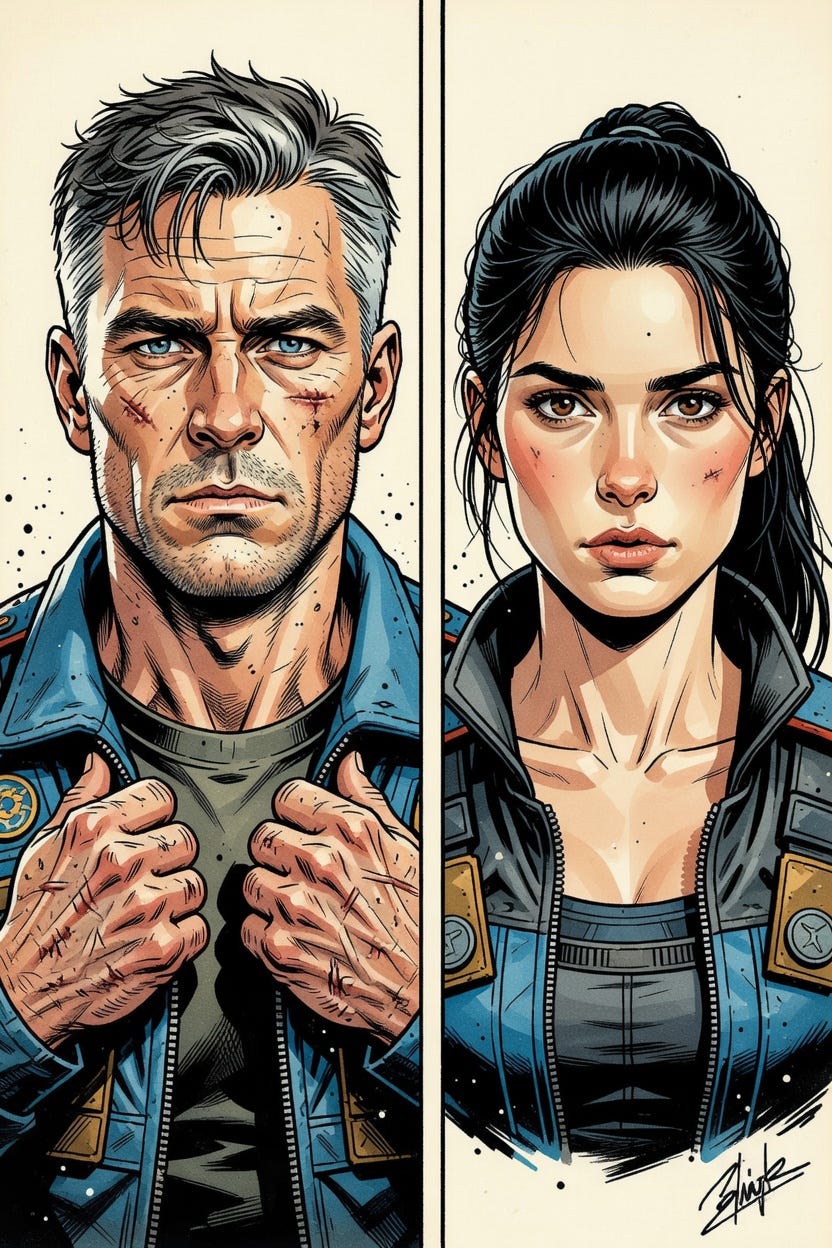
The desert stretched out like a promise of death.
Bishop had acquired the Toyota pickup forty minutes outside Tripoli. The owner had been cooperative once Bishop explained the situation. Which is to say, once Bishop had pointed the Glock at his face and told him to walk away. The man had walked. Fast. Bishop didn’t blame him.
Now the truck rattled south on a road that was more suggestion than reality. Potholes. Washboard sections that tried to shake the vehicle apart. Heat shimmer rising off the sand in waves that made the horizon dance.
One hour to the facility. Then five hours watching. Counting. Learning.
The compound sat in a depression between two low ridges. Old Soviet design, updated during the Gaddafi years, now serving whoever paid the electric bill. Chain-link fence, three meters high. Two guard towers. Main building squatting in the center like a concrete toad. Corrugated metal roofs. No windows on the lower level. The kind of place where screams stayed inside.
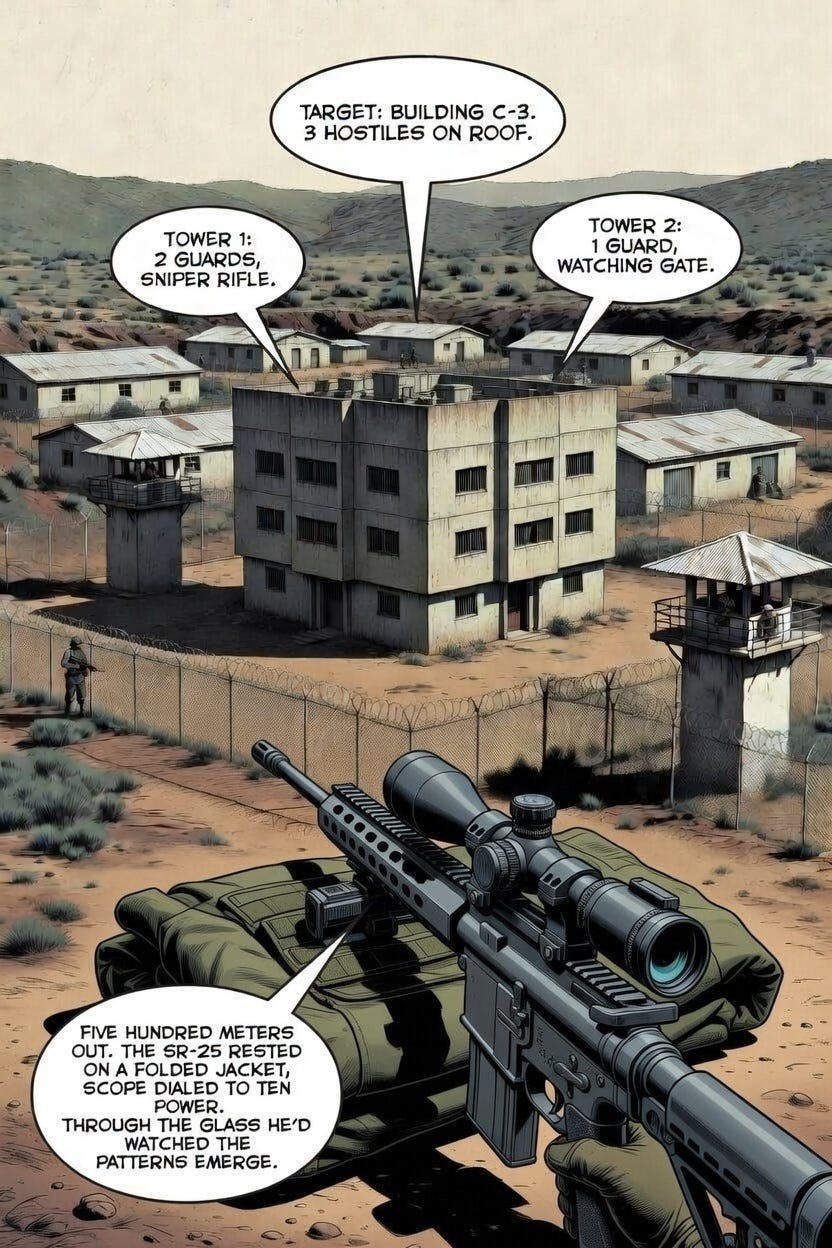
Bishop had positioned himself on the eastern ridge, five hundred meters out. The SR-25 rested on a folded jacket, scope dialed to ten power. Through the glass he’d watched the patterns emerge.
Two guards in the towers. Northeast and southwest. They rotated every four hours. Sloppy. Both of them smoking. One was reading something. Magazine or phone. Not professional.
Amateurs playing soldier, Bishop thought. They’ve never been hunted. Never known what it feels like to have crosshairs settle on the back of your skull.
He had. Too many times.
Two roving patrols. Four men total. They circled the perimeter every twenty minutes. Not staggered. Just offset by ten. Amateur hour. Someone had read a security manual and understood maybe half of it.
Ground level activity suggested more inside. Bishop had counted at least eight individuals entering or exiting the main building over five hours. Add the four roving patrol and the two tower guards. Fourteen hostiles, give or take. Maybe more in the basement if the old military blueprints Halim had mentioned were accurate.
Fourteen against one. Bishop had faced worse odds. Not often, and not recently, but the math was just math. If he was smart, if he was careful, if he was willing to do what needed doing, fourteen could become zero.
Syria had been worse. Twenty Three in that compound outside Raqqa, three years ago. Morrison on comms, talking him through.
The memory came unbidden. Morrison’s voice, steady and calm, counting down targets as Bishop moved through the building like death incarnate. Morrison had always known exactly what to say. Had known how to keep Bishop’s mind sharp when the bodies started stacking up.
Morrison was dead now. Killed six months later in Yemen, an operation gone sideways. A different mission, a different nightmare.
Bishop pushed the image away. Locked it in the same dark room where he kept everything else. The room was getting crowded.
The sun was dropping toward the western ridge. Twilight approached, the light softening, shadows stretching long across the sand. The golden hour. In another forty minutes, the light would fail entirely. But those forty minutes were optimal. The guards’ eyes would struggle with the transition. Day vision giving way to night. That in-between time when nothing looked quite real.
Bishop checked his watch. 1805 local. He’d give it fifteen more minutes. Let the light fade just enough. Let the guards settle into complacency as their shift stretched toward its midpoint.
They think they’re safe out here. They think the desert protects them.
The desert didn’t protect anyone. The desert just waited.
He ran the loadout one more time. Mental checklist, the same ritual he’d performed before every operation for twenty years.
Glock 19. Suppressed. Two magazines. Fifteen rounds each. Thirty rounds total. One magazine loaded, one spare. Close quarters weapon.
HK416. Suppressed. One hundred twenty rounds across four magazines. Thirty in the rifle, ninety in reserve. The workhorse.
SR-25. Suppressed. Eighty rounds of 7.62 across four magazines. Twenty in the rifle, sixty in reserve. Precision instrument.
Two frag grenades. One smoke. MTK fixed-blade knife. Electronic bypass for the locks. Flex cuffs. Med kit.
And in his jacket pocket, the pill bottle. Eleven capsules. He could feel them pressing against his ribs. Feel the promise of relief they offered. His back was screaming. The bruising from yesterday’s ambush had turned his entire left side into a canvas of purple and green. Every breath hurt. Every movement cost.
Just two. That’s all it would take. The edge would come off. The pain would become manageable.
Bishop left the pills where they were.
Not before. Not during. The pain keeps you sharp. The pain reminds you that you’re still breathing.
He’d seen what happened to operators who dulled themselves before contact. Had watched them make half-second mistakes that became permanent problems. Pain was information. It told you that you were alive. It told you where your limits were. He’d operate right up to those limits, and when this was done he’d reassess. But not before.
The eleven remaining pills felt like a countdown. To what, he wasn’t sure anymore. Recovery or oblivion. The line between the two had been blurring for years.
He glassed the facility one more time. The NE tower guard had put his rifle down. Leaning against the railing. Both hands near his face lighting a cigarette.
Enjoy it. Last one you’ll ever have.
The thought came without emotion. That was the part that bothered him sometimes. The disconnect. He was about to take a man’s life, and he felt nothing. Not anticipation, not dread, not satisfaction. Just the cold calculus of necessary action.
When did that happen? When did killing become paperwork?
Afghanistan, probably. Or maybe Yemen. Or maybe it was gradual, one death at a time, until the weight of it all compressed something vital in his chest into diamond. Hard. Small. Impervious.
Morrison would have had something to say about that. Some joke to break the tension. Some observation that cut right to the heart of things. But Morrison was dead, and Bishop was alone, and the jokes didn’t come anymore.
He settled into the rifle. Controlled his breathing. Found the balance point between heartbeats where the world went still. Five hundred meters was comfortable range for the SR-25. The scope brought the guard’s face into sharp relief. Young. Maybe twenty-five. Dark beard. A gold chain glinting at his throat.
Someone’s son. Someone’s brother, maybe.
The thought registered and was filed away. It didn’t matter. He’d chosen his side. Elena Varga was in that building, and every minute she spent there was another minute of pain, another chance for them to break her or decide she was no longer useful.
The SR-25 coughed. Soft. Polite.
The guard’s head snapped back. His body followed, tumbling off the tower platform and hitting the ground six meters below with an impact Bishop couldn’t hear but could imagine. Wet. Final.
He shifted aim to the SW tower. That guard had heard something. Was turning. Reaching for his radio.
Too slow.
The second round took him in the throat. He dropped out of sight behind the tower railing. Bishop waited. Counted to sixty. No alarm. No response. Both towers quiet and empty.
Twelve hostiles left.
Two down. Clean. Quick. They never knew what hit them.
Was that mercy? Bishop wasn’t sure anymore. He’d stopped trying to categorize his actions years ago. Good. Bad. Necessary. The words had lost their meaning somewhere between Kabul and Cairo.
Bishop moved. Low and fast down the ridge. The sand tried to betray him with noise, but he’d learned years ago how to walk in deserts. How to make his footfalls whisper instead of shout. He reached the fence on the north side, the section furthest from the main building, and pulled wire cutters from his pack.
The chain link resisted for a moment, then snapped with a soft click. Another link. Another snap. He worked methodically, each cut parting the fence with a metallic whisper. No drama. Just steel giving way to physics. He folded the flap back, slipped through, let it fall behind him.
Sixty meters to the building. Inside the compound now, the distance felt longer than the five hundred meters he’d covered from his observation post on the ridge. No cover except a slight roll in the terrain and the failing twilight. The light was perfect now. That purple-gray threshold between day and night. He went flat and crawled.
This is the part they never show in movies. The waiting. The crawling. The slow, patient work of becoming invisible.
His bruised ribs ground against rocks. Sweat ran into his eyes. His left shoulder screamed where he’d wrenched it during yesterday’s firefight. He ignored all of it. Became a shadow. Became nothing.
Just another piece of desert. Just another bit of heat shimmer and dust.
The thoughts helped. They kept his mind focused on the immediate, on the physical reality of dirt and pain and movement. When his mind wandered, it went to dark places. To Morrison in Yemen, years ago. To the contractors who’d died in the alley last night. To the question he’d been avoiding since this whole thing started.
Why me? Why was I the bait?
Someone had chosen him specifically. Had known where he’d be, what mission he’d be running, who he’d be with. That kind of intelligence didn’t come cheap. That kind of intelligence meant someone on the inside.
The thought settled in his gut like cold lead. Someone he knew. Someone he trusted. That was the only way this made sense.
He filed it away. Another problem for later. Right now, the only problem was the fifty meters of open ground still between him and the building.
It took fifteen minutes to cover the remaining distance. Glacial. Methodical. By the time he reached the building’s north wall his hands were raw and his breathing was ragged, but he was invisible. Just another piece of desert. Another bit of failing light and dust.
Bishop rose slowly. Pressed his back against the concrete. The wall was hot enough to brand flesh, even now as twilight deepened. He moved along it toward the main entry, the HK slung across his back now, the Glock 19 in his hands. Pistol work from here. Close. Quiet.
This is what you do. This is what you’re good at.
The thought wasn’t comfort. It was just fact. Some men built things. Some men fixed things. Bishop broke things. He broke them precisely and thoroughly and without hesitation. It was what he’d been trained for. What he’d been shaped into.
And what happens when there’s nothing left to break?
He pushed the thought away. The main door was ahead.
The door was heavy steel, painted green once, now mostly rust. It opened outward. Bishop could see the hinges on this side. Standard security installation. He pulled the electronic bypass from his pouch. Halim had promised it would work on anything short of mil-spec, and Halim had never lied to him.
The device clicked against the lock mechanism. Lights blinked. Red. Red. Amber. Green.
The lock disengaged with a soft click.
Bishop pulled the door open. Moved inside. Let the door close behind him with barely a sound.
The interior was cooler. Dark after the brutal twilight. He let his eyes adjust. Counted to ten. The world resolved into shapes.
A corridor stretched ahead. Forty meters. Doors on either side. Fluorescent bulbs overhead, but powered off. And fifteen meters down on the left, a guard station.
Two men. Both in mismatched military surplus. Both with AK-47s slung casually over chairs. Both looking at a portable television showing a boxing match.
Neither looking at him.
It looked like a recording of the infamous Tyson v Holyfield fight. Good Fight.
The absurdity of the thought almost made him smile. Almost. Here he was, ghost in a killing house, and his brain was cataloging a Thirty-year-old fight. The human mind was a strange thing. It found normal wherever it could.
Bishop moved forward. Silent. The Glock tracked between them. He closed the distance. Ten meters. Five. Three.
The first guard turned his head. Saw him. His eyes went wide.
Bishop shot him in the face. The suppressed round made a sound like a book slapping closed. The guard’s head rocked back. Blood painted the wall behind him in a Rorschach of bone and brain matter.
The second guard was faster. Was reaching for his rifle. Was opening his mouth to shout.
Bishop put two rounds into his chest. Center mass. The man made a sound between a cough and a gasp. He slid off his chair and hit the floor.
Ten left.
Three rounds. Three hits. The muscle memory is still there. Twenty years of repetition carved into your nervous system.
He moved past the guard station. The smell hit him. Copper and cordite. The voided bowels that came with violent death. He’d smelled it in a dozen countries. On four continents. It never got easier. It just got familiar.
Like whiskey. Like the pills. Like everything that was supposed to be temporary.
He checked the first door on the right. Storage. Mops. Cleaning supplies. Clear.
Second door on the left. Admin office. A man in shirtsleeves sat at a desk. Officer. Mid-forties. Gray hair. He looked up as Bishop entered.
“What...”
Bishop shot him twice. The man folded over his desk. Papers scattered. A coffee mug rolled off the edge and shattered on the concrete floor.
Nine left.
Movement behind him. Bishop spun. A guard had emerged from a room at the far end of the corridor. Young. Panicked. Bringing his AK up.
His hands are shaking. First combat. He won’t survive it.
Bishop’s first round caught him in the shoulder. Spun him. The second went through his throat. He dropped. The AK clattered away across the floor.
Six rounds expended from the Glock. Twenty-four remaining.
Eight left.
Then the radio on the dead guard’s belt squawked. Static. A voice. Accented. Tense.
“Tower Two, status check.”
Silence.
“Tower Two, respond.”
More silence.
“Tower One, do you copy?”
The voice changed. Sharper. No longer asking. “All units, security alert. Towers are not responding. Lock down protocol. Repeat, lock down protocol.”
Lights shifted from white to red. A klaxon started wailing somewhere in the building’s guts. Heavy doors slammed shut at both ends of the corridor.
Stealth was done.
So we do it the loud way.
Bishop holstered the Glock and brought up the HK. The suppressor wouldn’t hide him now. It would just keep him from going deaf in the enclosed space.
He heard boots. Multiple sets. Coming from the right. From deeper in the building.
The first hostile came around the corner fast. Tactical posture. AK up. He saw Bishop and tried to bring the rifle on target.
Bishop shot him three times. The man went down hard.
A second appeared behind the first. Then a third. They’d stacked up. Never push a threat in a straight line. Bishop held the trigger. The HK416 sang its short, brutal song. Suppressed rounds punched through flesh and bone and struck the wall behind them. Both men collapsed into each other. A tangle of limbs and blood and weapons that clattered against concrete.
Five left. Not counting Kazan. If Kazan was even here.
He’s here. Men like Kazan don’t delegate the interesting work. He wants to watch. To control.
Bishop moved forward. Past the bodies. His boots squelched in spreading blood.
How many now? How many over twenty years?
He’d stopped counting a long time ago. The number was just a number. What mattered was whether they deserved it. Whether the cause was worth the cost.
And what cause are you serving now? Revenge? Justice? Or just the need to keep moving because stopping means thinking?
The corridor ended at a T-junction. Left led to more rooms. Right led to stairs going down.
Down was where they’d keep prisoners.
Bishop went right.
The stairwell was narrow. Concrete walls on both sides. Single bulb hanging from a wire, swaying in some invisible current. Red emergency light pulsing. Each step down felt like descending into something older than this building. Older than war. Some primal place where humans hurt each other because hurting was all they knew.
You know this place. You’ve been here before. Different building, same darkness.
A guard waited at the bottom. Stationed at a metal door that had to lead to the cell block. He saw Bishop coming. Tried to bring his AK up in the narrow space.
Bishop kicked the barrel aside. Slammed the rifle stock into the man’s face. Felt the nose crumple. Felt teeth break. The guard went down. Bishop shot him once. Made sure.
Four left. Kazan unaccounted for.
The metal door was locked. Bishop used the bypass again. It took longer this time. Twenty seconds that felt like twenty years. The klaxon kept wailing. Footsteps echoed somewhere above him. Shouts in Arabic and English and Russian. The facility was a hornet’s nest now. Angry. Organized. Searching.
They know you’re coming. They’re preparing. But they don’t know what you are. They think you’re human.
The lock clicked open.
Bishop pushed through into the cell block. Four heavy doors. All closed. All with small windows at eye level. He moved to the first. Looked through.
Empty.
Second door. Empty.
Third door. A figure on a cot. Female. Dark hair matted with sweat and blood. She raised her head as his shadow fell across the window.
Elena Varga.
Her face was bruised. Left eye swollen half-shut. Split lip. But her eyes were clear. Focused. Alive.
She’s still fighting. Two days of interrogation and she’s still in there.
Something shifted in Bishop’s chest. A recognition. He’d seen that look before, in operators who’d survived the worst that the world could throw at them. It was the look of someone who refused to break.
Maybe she’s worth saving. Maybe this isn’t just about revenge.
Bishop checked the lock. Heavy deadbolt. External. He threw it and pulled the door open. It swung outward on hinges that shrieked.
Elena stood slowly. She was wearing the same clothes from the abduction. Tactical pants torn at the knee. Black shirt stained with blood that might have been hers or someone else’s. She looked at Bishop the way you’d look at a hallucination. Uncertain if it was real.
“Who are you?”
“A friend of a friend.” Bishop kept his voice low. “Can you walk?”
“Yes.”
“Can you run?”
“If I have to.”
“You’re going to have to.” He pulled the Glock from his holster. Handed it to her. “You know how to use one of these?”
She took it. Checked it with practiced hands. “I’m a journalist, not an idiot.”
“Good.”
She handles it like she’s done it before. Not just training. Experience. There’s more to her than Halim suggested.
A sound behind him. Bishop turned. A man stood in the doorway to the cell block. Late forties. Weathered. Operator’s eyes. HK416 in his hands. Not raised yet. Not pointed. Just there.
Viktor Kazan. Had to be.
“You must be Bishop.” Kazan’s English was good. Eastern European accent underneath. Russian, maybe Ukrainian. “They said you were dead.”
“They were wrong.”
“Obviously.” Kazan’s eyes flicked to Elena. Back to Bishop. “You’re making a mistake.”
“Wouldn’t be the first time.”
His stance is too relaxed. He’s done this before. He thinks he has an edge.
“She’s not worth dying for. She’s just a journalist. All she has are questions. No answers.”
“Then why torture her?” Bishop asked.
Kazan smiled. It didn’t reach his eyes. “To make sure.”
There. His weight shifted to his back foot. He’s about to move.
His rifle started to come up.
Bishop fired first. Three rounds. Center mass. Kazan stumbled back. Hit the wall. His rifle clattered to the floor.
But he was wearing plates. Body armor. The rounds had knocked him down but hadn’t penetrated.
Ceramic. Level IV, probably. Should have gone for the head.
Kazan’s hand went to his thigh. Came back with a knife. He pushed off the wall. Came at Bishop low and fast.
Bishop brought the HK416 around. Too slow. Too close. Kazan batted the barrel aside. The knife came up. Aimed for Bishop’s gut.
Bishop twisted. The blade caught his left shoulder instead of his stomach. Went in clean. Two inches. Maybe three. Pain exploded through his arm. White hot. Blinding.
Don’t scream. Screaming is air you need for fighting.
He dropped the rifle. Let it fall. His right hand found his own knife. The MTK. He ripped it from the sheath and drove it up under Kazan’s chin.
The point went through soft tissue. Through tongue and palate. Into the brain cavity.
Kazan’s eyes went wide—pupils blowing out like black ink in water. His mouth worked, trying to form words around the steel lodged in it. A wet, choking gurgle escaped instead, blood bubbling at the corners of his lips and running in thick ropes down his neck.
The knife was still in Bishop’s grip, buried to the guard. He felt the frantic flutter of Kazan’s tongue against the blade, the spasmodic clench of jaw muscles trying to bite down on metal that wouldn’t give. Their faces were inches apart. Bishop could smell the copper tang of blood, the sour edge of fear-sweat, the faint chemical bite of gun oil on Kazan’s gear.
Kazan’s left hand shot up, fingers clawing at Bishop’s wrist—not to pull the knife free, but to hold it there, as if letting go would mean admitting it was over. His right hand fumbled weakly for the pistol still holstered at his thigh, but the strength was bleeding out of him fast. Fingers brushed the grip, slipped, tried again.
Bishop leaned in closer, voice low and steady despite the fire in his shoulder.
“You’re done,” he said. “Feel it?”
Kazan’s eyes locked on his. Not pleading. Not angry. Just… present. A final, animal clarity. The hand on Bishop’s wrist tightened once—hard—then slackened. His breathing turned shallow, wet rattles. Blood frothed with every exhale, painting Bishop’s knuckles crimson.
Kazan tried one last time to speak. The sound came out mangled, a syllable drowned in red:
“…not… yet…”
Bishop felt the tremor start in Kazan’s core—muscles seizing, then releasing in waves. The grip on his wrist went limp. The right hand fell away from the pistol, fingers curling once like a dying spider.
For three more heartbeats Kazan stayed upright, held there by the knife and sheer stubborn will. Then the light in his eyes flickered—once, twice—and dimmed.
Bishop twisted the blade a quarter turn. Just enough.
Kazan’s body jerked once—hard—like a marionette with its strings cut wrong.
Bishop stood there. Gasping. His left shoulder was on fire. Blood ran down his arm. Soaked his sleeve. Dripped from his fingers.
The pain is good. The pain means you’re alive. The pain means you can still feel something.
He pulled Kazan’s knife out. Looked at it. Six inches of carbon steel. Good blade. He dropped it on the body.
Elena was beside him. Her hands on his shoulder. Assessing the damage.
“How bad?” Bishop asked.
“Bad enough. Missed the artery but you’re bleeding hard.” She tore a strip from her shirt. Started wrapping it tight around the wound. “You need a hospital.”
“Later.”
“You’ll bleed out.”
“Later.” Bishop picked up his rifle. It felt heavier now. Everything felt heavier. “We need to move.”
She’s calm. Efficient. Two days of torture and she’s putting pressure on a wound like she’s done it a hundred times.
“They’ll be waiting.”
“I know.”
She’s right. The remaining hostiles will have consolidated. Probably covering the stairs. Smart play would be a funnel point where they can concentrate fire.
He moved to the stairs. Listened. Footsteps. Multiple sets. Coming down.
Two of them. Maybe three. Moving in formation. These ones have training.
Two grenades left. Bishop pulled the frag. Yanked the pin. Counted to two. Then threw it up the stairwell.
He pressed himself against the wall. Pulled Elena close. The explosion was a physical thing. A fist of overpressure that slammed the air from his lungs. Dust and smoke billowed down the stairs. Screaming. The wet sounds of shrapnel finding flesh.
That sound. The screaming. It used to bother you. Now it’s just data.
Bishop went up. Through the smoke. Through the carnage. Bodies on the stairs. One still moving. Bishop shot him. Kept moving.
The corridor was chaos. Red lights flashing. Klaxon still wailing. Smoke creeping along the ceiling. But the ground level was clear. The hostiles had concentrated on the stairs. Had tried to trap him below.
Fatal mistake.
Bishop and Elena moved toward the main entry. His shoulder was agony. Each movement sent fresh waves of pain radiating down his arm. His left hand wasn’t working right. Fingers weak. Grip uncertain.
The body is failing. Too much blood loss. Too much accumulated damage. You’ve been running on adrenaline and spite for too long.
He was running on adrenaline and will. When those ran out, he’d stop moving. Simple as that.
They reached the entry. Bishop checked the door. Pulled it open.
The vehicle yard was sixty meters away. Three vehicles. Two Suburbans. One technical with a mounted gun.
And two more guards running toward the building from the perimeter. They saw Bishop. Started firing. AK rounds sparked off the concrete. Chewed up the ground.
Bishop pulled Elena back inside. Slammed the door. “We need another exit.”
“There.” She pointed to a door at the corridor’s end. “I heard them coming and going that way during...”
She didn’t finish. Didn’t need to.
During the torture. When they took breaks to rest their hands.
They moved. Bishop’s vision was starting to gray at the edges. Blood loss. Shock. The body’s way of telling him that it had limits and he’d found them.
Not yet. Just a little further. You don’t get to die here. Not like this.
The rear door led to a storage area. Generator. Fuel drums. And beyond that, the fence.
They ran. Bishop’s boots felt like they weighed a hundred pounds each. Elena stayed with him. Matched his pace. She was strong. Tougher than she looked.
Tougher than most operators I’ve worked with. She’s been through hell and she’s still moving. Still fighting.
The fence was three meters of chain link. Bishop pulled the wire cutters from his belt with his right hand. His left arm hung useless at his side. He cut. The links snapped and parted with metallic clicks. Not fast enough. The cutters felt like they were made of lead.
Shots behind them. The guards had flanked around. Were coming from the building.
Bishop kept cutting. Made a hole. Big enough.
“Through,” he told Elena.
She went. He followed. The fence grabbed at his gear. At his injured shoulder. Pain flared white and terrible. He gasped. Kept moving.
They were outside the perimeter. Bishop turned. Brought up the HK416 one-handed. Fired back at the approaching guards. The rifle bucked against his grip. He couldn’t control it as well with one hand. The rounds went wide. But it made the guards drop. Made them seek cover.
Bought seconds.
Seconds were enough.
Bishop and Elena ran for the vehicle yard. The Suburbans were right there. Keys might be inside. Might not. He’d hotwire if he had to.
They reached the nearest Suburban. Bishop yanked the door open. Climbed in. Elena got in the passenger side.
Keys in the ignition. Whoever had driven it had been arrogant. Confident this facility was secure.
Arrogance kills. It’s the one lesson that never gets old.
Bishop turned the key. The engine roared to life.
Rounds sparked off the hood. The windshield spiderwebbed but held. Armored glass. These were the same vehicles from the abduction. Built for protection.
Bishop put it in drive. Floored it.
The Suburban rocketed forward. Smashed through the chain-link gate. Fishtailed on the loose sand. Bishop fought the wheel one-handed. Got it under control. Pointed it north.
Toward Tripoli. Toward something that might be safety. Toward anything that wasn’t that nightmare of concrete and blood behind them.
He checked the mirror. No pursuit. Not yet.
They’re regrouping. Counting their dead. Trying to figure out what hit them.
Bishop’s shoulder was still bleeding. The makeshift bandage Elena had tied was soaked through. Red blooming across his entire left side. His vision kept trying to narrow. Kept trying to go dark.
Stay conscious. Stay focused. You’ve been worse than this. You’ve survived worse than this.
Had he? He wasn’t sure anymore. The years blurred together. The wounds accumulated. Each one taking a little more, leaving a little less.
“Stay with me.” Elena’s voice. Firm. Professional. “Don’t you dare pass out.”
“Wasn’t planning on it.”
“How far to the city?”
“Forty kilometers. Maybe thirty minutes.”
“You going to make it thirty minutes?”
“Ask me in thirty-one.” He glanced at her. “What they did to you. In there. You okay?”
She was quiet for a moment. Then: “No. But I will be.”
Honest answer. No bravado. No pretense. She knows what she’s carrying and she’s not pretending it doesn’t weigh anything.
“Good.”
“They wanted to know what I found. What I know about PROMETHEUS.”
Bishop kept his eyes on the road. The desert streamed past. Empty. Indifferent. “Did you tell them?”
“I couldn’t.” Her voice was strange. Flat. “The information is memorized. Coded. I can’t decode it without a key. And I don’t have the key.”
Smart. Compartmentalized information. Even under torture, she couldn’t give them what she didn’t have access to.
“Who does?”
She looked at him. Her face was bruised and bloodied but her eyes were hard. Determined. “The man who gave it to me. The man who recruited me to investigate PROMETHEUS in the first place.”
“Name.”
“Not yet.” She shook her head. “First I need to know who you really are. Why you came for me. Who sent you.”
“Nobody sent me. I’m just a guy who was in the wrong place at the wrong time.”
“Bullshit.”
Bishop almost laughed. It came out as a cough. “You’re right. I’m a guy who got used as bait for your abduction. They killed my team to get to you. I want to know why. And I want to make the people responsible pay for it.”
“That’s all?”
“That’s enough.”
It’s not, though. Is it? It’s not just about the contractors who died in that alley. It’s not just about revenge. It’s about finding out why you were disposable. Why someone decided you weren’t worth keeping.
She studied him. Measuring. Then nodded. “Okay. I can work with that.”
“So who has the key?”
Elena turned her eyes back to the road. “His name is Conrad Ashworth. He’s CIA. At least, that’s who he says he is. He might be something else entirely.”
The name meant nothing to Bishop. Just another piece of the puzzle. Another thread to pull.
Ashworth. CIA or something wearing a CIA mask. Either way, he’s the next target. The next door to kick in.
“Where do we find him?”
“I don’t know. He finds me. Always has.” She touched her swollen eye. Winced. “But he’ll surface when he hears I’m out. PROMETHEUS will make sure of that. They want what I know as badly as he does.”
Bishop processed this. “So we wait.”
“We wait. And we prepare. Because when Ashworth shows up, we’re going to be walking into something even worse than what we just left.”
“Looking forward to it.”
Another lie. You’re not looking forward to anything. You’re just moving forward because standing still means thinking. And thinking means facing what you’ve become.
The desert gave way to scrubland. Scrubland gave way to scattered buildings. The outskirts of Tripoli. Bishop’s hands were shaking on the wheel. His left arm hung dead. His vision kept doing things vision wasn’t supposed to do.
But they’d made it.
He’d gone in alone against fourteen hostiles. Had come out with the objective.
The math had worked.
Barely.
“There’s a safehouse,” Bishop said. His voice sounded distant. Like it belonged to someone else. “North side of the city. We’ll go there. Get you cleaned up. Figure out next steps.”
“You need a doctor.”
“I need twenty minutes horizontal and about a gallon of water.” He glanced at her. “Then we start hunting.”
Elena nodded. “Then we start hunting.”
Bishop drove. The city rose around them. The Suburban blended into traffic. Just another vehicle in a city full of them.
Behind them, in a desert facility that would be abandoned by nightfall, fourteen men lay dead. Their blood soaked into concrete that had seen so much blood before. Their last moments had been terror and violence and the sudden knowledge that they’d made a fatal mistake.
They’d underestimated the man with the gray eyes and the steady hands and the absolute refusal to leave anyone behind.
Viktor Kazan had died wondering who Bishop really was. Where he’d come from. What force of nature had carved its way through his facility like judgment itself.
He’d died without an answer.
And in the passenger seat of a stolen Suburban, a woman who held secrets that could topple governments rode with her rescuer toward a reckoning that neither of them could see but both of them knew was coming.
PROMETHEUS had made a mistake.
They’d tried to make Elena Varga disappear.
Instead, they’d made her a weapon.
And Bishop knew how to aim weapons.
The sun was setting when they reached the safehouse. Bishop parked in an alley behind a shuttered electronics shop. Cut the engine. Sat there for a moment, breathing. Just breathing.
Fourteen men. Fourteen lives. Fourteen families who’ll never see them again.
The thought came unbidden. He let it pass. There was no room for that kind of thinking. Not anymore. Maybe not ever again.
“Can you walk?” Elena asked.
“Can you?”
“I asked first.”
Bishop opened his door. Stepped out. His legs held. Barely. Elena came around the front of the vehicle. She was limping slightly. Her face was a mask of bruises. But she was moving. Functional.
She’s still standing. After everything they did to her, she’s still standing.
Something like hope flickered in his chest. He crushed it immediately. Hope was dangerous. Hope made you careless.
They went inside together. Up the stairs that groaned. Into the room that smelled like rust and old secrets.
Bishop locked the door. Checked the window. No immediate threats. He crossed to the cot. Sat down hard. His shoulder was still bleeding. Not as badly. The blood had clotted in places. But it needed proper attention.
Elena found the med kit. Started cleaning the wound. Bishop watched her work. Efficient. Practiced. More than just a journalist who’d had first aid training.
“You’ve done this before,” he said.
“I worked ER trauma before I turned to journalism. Twelve-hour shifts in Baltimore. You see enough knife wounds, you learn how to treat them.”
“Why’d you switch?”
“Wanted to stop the bleeding at the source. Stop the violence before it made it to the hospital.” She looked at him. “How’s that working out?”
“About as well as you’d expect.”
She almost smiled. “Yeah. That’s what I figured.”
She’s human. Under all the training and the secrets and the encoded information, she’s human. She wanted to make a difference.
So did you, once. Remember?
She finished cleaning the wound. Packed it with gauze. Wrapped it tight. Bishop’s shoulder was fire and agony and protest. But the bleeding had stopped.
“You need antibiotics,” Elena said. “And probably a tetanus shot.”
“I’ve had worse.”
“I’m sure you have.” She sat back. Looked at him. Really looked at him. “Thank you. For coming for me. I know you didn’t have to.”
“Yes I did.”
“Why?”
Bishop didn’t answer right away. He thought about Morrison. Thought about his team, bleeding out in an alley. Thought about the voice on the radio telling him he was just bait. Just a piece to be moved and discarded.
Because someone has to. Because if I don’t, then all of it was for nothing. All the killing. All the dying. All the pieces of myself I’ve left scattered across a dozen countries.
“Because someone has to,” he said finally. “And it might as well be me.”
Elena nodded. Like that made sense. Like that was enough.
Maybe it was.
Outside, the city noise rose and fell. Voices. Traffic. Life continuing while they sat in a room full of weapons and blood and the aftermath of choices that couldn’t be unmade.
Bishop reached into his pocket. Pulled out the pill bottle. Looked at it for a long moment.
Eleven capsules. Eleven chances to make the pain stop. Eleven steps toward something you’re not ready to name.
Then he opened it. Shook two capsules into his palm.
Elena watched. Said nothing.
He swallowed them dry. Felt them go down rough. Tasted bitter.
“For the pain?” she asked.
“For everything.”
For the pain. For the memories. For all the men who’ll never go home. For Morrison. For the team. For the parts of yourself that died so long ago you can’t remember what they looked like.
They sat in silence as the moon filled the sky. As darkness crept into the corners. As the city outside became a pattern of lights that meant nothing and everything.
Tomorrow they’d start hunting Conrad Ashworth. Tomorrow they’d decode whatever secrets Elena carried. Tomorrow they’d begin pulling apart PROMETHEUS thread by thread.
But tonight, they were alive.
Against odds that said they shouldn’t be.
Against forces that wanted them dead.
Against a world that didn’t care either way.
Bishop closed his eyes. Let the pills do their work. Let the pain recede to something manageable.
Nine pills left. Nine steps. Nine chances to decide what kind of man you want to be when this is over.
If you’re still alive when this is over.
When he opened them again, Elena was watching him. Her bruised face unreadable in the dim light.
“Get some sleep,” Bishop said.
“You first.”
“I don’t sleep.”
“Everyone sleeps.”
“Not me. Not in places like this.”
“Then I guess we’ll both stay awake.” She leaned back against the wall. Closed her eyes. “Wake me if someone tries to kill us.”
“Will do.”
The room settled into stillness. Bishop’s shoulder throbbed despite the pills. His ribs ached. His body cataloged a dozen new damages that would become tomorrow’s problem.
But he’d completed the mission.
Elena Varga was alive.
Whatever came next, they’d face it together.
And somewhere in the shadows, the people who’d orchestrated all of this were learning a lesson they should have known from the beginning.
Don’t send a man to die unless you’re absolutely certain he won’t come back.
Because if he does come back, he’ll bring hell with him.
Then the euphoria hit. The warm tingles washed over him and he finally relaxed.
Just finished Chapter 3! Great work, Dallas, I couldn’t put it down. Now looking forward to learning more about Elena.
Can't wait to read Chapter 3! The visuals are fantastically well done. Above all else, it's the writing and Bishop's voice that's drawing me in.